| The Whole Interior Environment | 1 / Design Basics 2 / The Whole Interior Environment 3 / Application to the Design 4 / Environment Worksheet |
Architectural Context
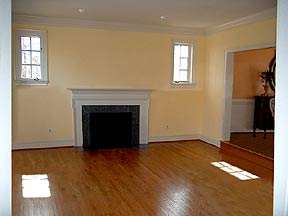
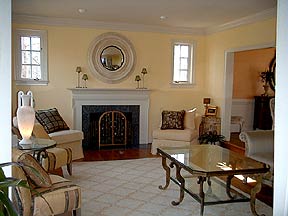
Below you will find a set of questions and answers for the room you see to the right. We've answered them here, and then included a blank Environment Worksheet for you to use on your own space. This information will allow you to draw a more accurate and practical floor plan.
 Questions:
Q:
What
is the shape of the room? (Measure the dimensions including ceiling
height)
A:
Rectangular,
19'6"l X 15'8"w X 9'5"h
Q:
Where
are the windows?
A:
East
wall (3) and South wall (2) flanking fireplace
Q:
What
are their shapes?
A:
Rectangular,
7'l" X 3'6" w
Q:
What
trim and molding do you see?
A:
Crown
molding 10" deep, baseboards 8" high, 6" windows
and doorframes
Q:
What
are the prominent architectural features?
A:
Fireplace,
decorative mantel and rich crown moldings
Interior Elements and Materials
 Questions:
Q:
What
is covering the walls, floors and ceilings? (Is it paint, wall
paper, cardboard, stucco, metal, carpet, etc.)
A:
Walls
and ceiling-eggshell antique white paint; Flooring-Oak, natural
matte finish hard wood
Q:
What
furniture and decorative accessories are in the room?
A:
One
couch, pair of club chairs, pair of upholstered chairs, one large
coffee table, one small circular table, convex mirror, large
canvas picture, alabaster lamp, small wood end table with fringed
lamp, various votive lights and vases
Q:
How
is the furniture arranged?
A:
Predominantly
around south, west and east walls, in a U shape.
Q:
What
colors are apparent?
A:
Chamois
yellow, cream, sage green, metallic accents
Q:
What
types of fabrics and textiles do you find?
A:
Sheer
organza, silks, velvets and damasks
Q:
Is
the room formal or casual?
A:
Formal
Q:
Is
there a collection or theme that seems apparent?
A:
Italian
villa
Intentions, Perception, Use
Questions:
Q:
What
is the intended activity for the space?
A:
Primarily
entertaining and greeting guests. Occasional family gatherings
Q:
Does
it appear to allow that function easily and comfortably?
A:
Primarily
but could be improved
Q:
Is
there sufficient light for the activity?
A:
No
Q:
How
may people can the space comfortably hold?
A:
8-10
seated and up to 20 standing
Q:
Is
that number appropriate for the intended activity?
A:
Yes
Q:
Is
the mood of the room reflective of the activity?
A:
Yes
Q:
Does
the room connect to other spaces that accent the intended activity?
A:
Yes,
the room is adjacent to the formal foyer and the dining room
Q:
Who
uses the space?
A:
Friends,
family and the homeowners
Q:
What
are the ages and frequency?
A:
Primarily
adults. We entertain a great deal and use the space 20 times
a year.
Q:
Is
the room designed for the people and activity?
A:
Primarily.
This exercise is intended to help you look at how each part effects the outcome of a space. Correctly analyzing the parts allows us to determine which elements to use and how to arrange them into patterns. This process allows us to assign value to specific solutions and clarify issues such as budget, timing and aesthetic choices.
As you look at the parts, visualize how they all relate. "These physical settings satisfy our basic need for shelter and protection; they set the stage for and influence the shape of our activities; they nurture our aspirations and express the ideas which accompany our actions; they affect our outlook, mood, and personality." (Ching, pg. 46, Interior Design Illustrated).
Now that we have looked at all these parts of the interior environment, lets apply this to the Design Process.
Previous / 1 / 2 / 3 / 4 / Next
Subscribe to our free and extremely informational newsletter. We would love to have your comments at: mail@designintuit.com
Welcome / What We're About / Focus on Annapolis / Marco Polo's Quest / Michelangelo's Den / Great Sites & Sources / Reading / Tiles & Textures / Tools & Terms / Contact Us
This site design and text © DesignIntuit, 2001